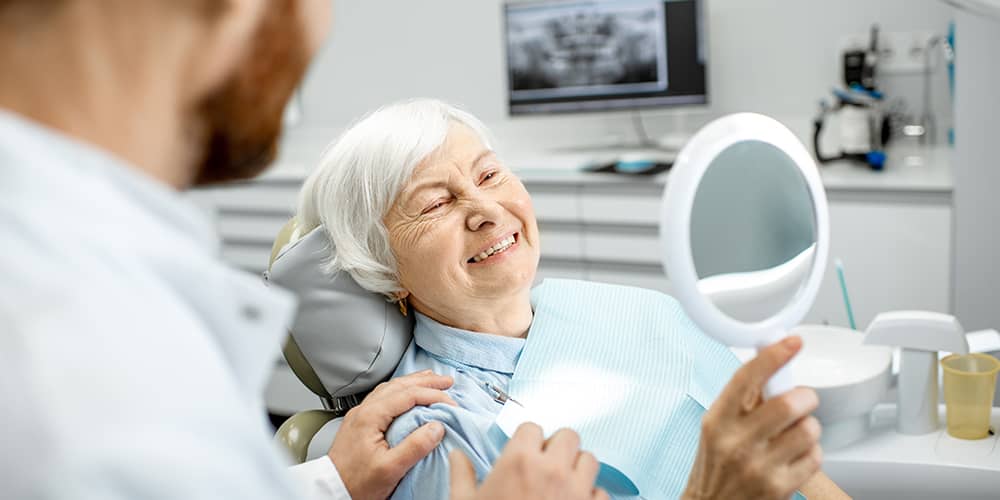
Denture Options at Our Queens, NY Dental Office
We offer three main types of dentures, and our Queens dentists will help you determine which is the best fit based on your oral health, bone density, and lifestyle:
Full Dentures (Complete Dentures)
Full dentures replace an entire arch of missing teeth — upper, lower, or both. If you've lost all your natural teeth due to periodontal disease, tooth decay, or injury, complete dentures restore your ability to chew, speak, and smile confidently.
Traditional full dentures rest on the gums and are held in place by natural suction and, when needed, denture adhesive. They're custom-crafted to match your facial proportions and the natural appearance of healthy teeth and gums.
Removable Partial Dentures
Partial dentures are used when you still have some healthy natural teeth remaining. They fill in the gaps left by missing teeth, fitting snugly between your existing teeth and attaching with small clasps or precision attachments.
In addition to restoring your smile's appearance, partials prevent your remaining teeth from shifting position over time — protecting your bite alignment and overall oral health. For patients with one or a few consecutive missing teeth, a dental bridge may also be worth comparing.
Implant-Supported Dentures and Partials
For patients who want the stability of implants with the coverage of a denture, implant-supported dentures offer the best of both worlds. Rather than relying on suction or adhesive, these dentures snap securely onto dental implant posts embedded in the jawbone.
Benefits over traditional dentures include:
- No slipping or shifting while eating or speaking
- Stronger bite force — closer to natural teeth than conventional dentures
- Jawbone stimulation that slows bone loss over time
- Greater comfort — no sore spots from rubbing against the gums
- Improved confidence — no worry about dentures moving in social situations
Implant-supported dentures are available in both fixed (permanently attached) and removable versions, depending on your preference and bone health. Learn more on our dental implants page.
Immediate Dentures
Immediate dentures are placed the same day your teeth are extracted, so you're never without a smile during healing. While your gums and jawbone heal over the following months, your immediate denture may need periodic adjustments or a reline to maintain a proper fit as swelling subsides and tissue changes shape. Once healing is complete, many patients transition to a final, permanently-fitted denture.
Implant-Retained Dentures — A Closer Look
Implant-retained dentures are similar in appearance to traditional dentures — featuring a gum-colored acrylic base supporting natural-looking artificial teeth made from porcelain, ceramic, or resin. The critical difference is how they're anchored.
During your procedure at our Queens dental office, four to eight dental implants are surgically placed below the gumline into the jawbone. These implant posts act as artificial roots, giving the denture a strong, durable, and stable foundation that doesn't depend on natural suction or adhesive — both of which can be unreliable and inconvenient.
The result is a denture that stays firmly in place, feels more natural when chewing and speaking, and maintains the health of your jawbone by providing the stimulation that bone needs to stay dense. For anxious patients, this procedure can be performed comfortably with sedation dentistry.
The Denture Process — What to Expect
Getting custom dentures at Kew Gardens Dental Arts takes several appointments over a few weeks. Here's what the process looks like:
Step 1 — Consultation & ExamWe begin with a thorough dental exam and X-rays to assess your oral health, bone structure, and the condition of any remaining teeth. If any extractions are needed first, we'll coordinate those as part of your overall treatment plan — our Queens office also offers gentle tooth extractions.
Step 2 — Impressions & MeasurementsHighly accurate impressions and bite measurements are taken and sent to a dental lab where your custom denture is crafted to precise specifications.
Step 3 — Try-In AppointmentsOne or more try-in appointments allow us to evaluate the shape, color, and fit of your denture before it's finalized. Your feedback at this stage ensures the result looks and feels exactly right.
Step 4 — Final Placement & AdjustmentAt your final appointment, your completed denture is placed and precisely adjusted for comfort and function. Minor adjustments after delivery are normal and expected — your mouth needs time to adapt.
What to expect after getting dentures: Increased saliva flow, mild soreness, and temporary difficulty with speech and chewing are all normal in the first few weeks. These symptoms resolve as your muscles and tissues adjust to the new appliance.
Caring for Your Dentures
Proper care extends the life of your dentures and protects the health of your gums and remaining teeth:
- Clean daily using a soft denture brush and a cleaner specifically formulated for dentures — never use regular toothpaste, which is too abrasive and can scratch the surface
- Rinse after meals to remove food particles
- Soak overnight in a denture bath solution to maintain their shape and prevent drying
- Handle with care — dentures can crack or break if dropped; always clean them over a folded towel or basin of water
- Keep up with regular dental checkups — even patients with full dentures need periodic gum and bone evaluations
- Don't skip relines — as your jaw naturally changes shape over time, dentures may need periodic relining to maintain a proper, comfortable fit
